
A practical guide to AI data annotation from the team at Humyn Labs
| TL;DR AI data annotation is the work of tagging raw images, video, audio, and text so machine learning models can learn from them. A model copies whatever you feed it, so weak labels quietly drain accuracy once you reach production. This guide to data labeling walks you through the types, the workflow, the true costs, the quality checks, and how to choose a partner you can rely on. Read it once and you will recognize good labeling on sight, along with what poor labeling costs you down the line. |
| What is AI data annotation? It is the practice of labeling raw data so machine learning models learn to see, read, and hear. Annotators outline objects, transcribe speech, tag sentiment, and mark entities in text. Those labels decide whether your model performs or breaks. Why does data labeling quality matter? Because a model believes every label you hand it. A one percent error across millions of points snowballs into a model that fails where it counts. Strong labels build accuracy. Weak ones drain your budget, your time, and your trust. |
Your Model Learns Exactly What You Teach It
Most teams point the finger at the algorithm when a model disappoints. They retrain. They adjust parameters. They throw more compute at the problem. And the real offender sits quietly inside the training data the entire time. Feed it bad labels, and bad predictions come right back out.
Nobody says this part out loud. Your model holds no judgment of its own. It mirrors the labels you give it, mistakes and all. So when annotation gets rushed or handed to people who do not know the domain, the errors do not disappear. They hide. Later they surface in production, where repairs cost the most.
This is where solid data annotation proves its worth. Get it right and you stand on firm ground. Get it wrong and you stand on sand, then puzzle over why the whole thing keeps sliding. At Humyn Labs, we work in the territory machines cannot reach, where nuance lives and judgment truly counts. This guide shows you how that plays out, and why it shifts your results. So where does the work actually start? With understanding what annotation means.
What Data Annotation Actually Means, No Jargon
Cut the buzzwords and it gets simple. Data annotation means teaching a machine to grasp raw information by tagging it with meaning. You show the model thousands of examples, each one labeled, and it picks up the pattern. That is the entire trick.
Here is how that plays out across the main data types:
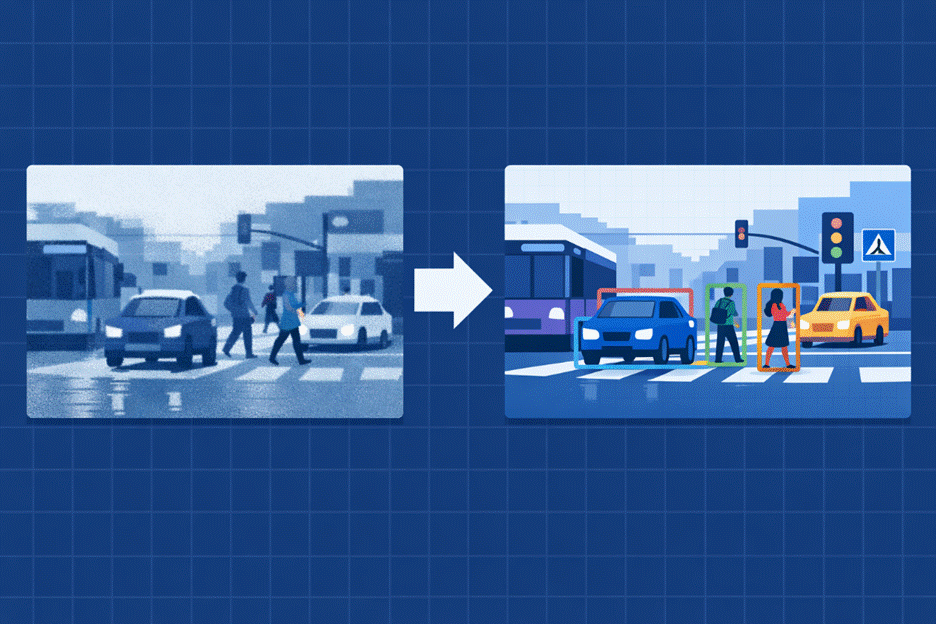
- Images. You outline a car so the model learns what a car is.
- Video. You follow that car across frames so the model learns motion.
- Text. You mark a sentence as angry or calm so the model learns sentiment.
- Audio. You transcribe a recording so the model learns speech.
People debate whether to say annotation or labeling. In the AI world they point to the same thing. Some use labeling for simple sorting and annotation for heavier work like segmentation. Do not get stuck on it. This guide to data labeling treats them as one craft, because that is how the work feels in practice. Once the meaning is clear, the next question is what kinds of annotation exist.
See also: Tech Waste Recycling: A Comprehensive Guide to Sustainable IT Disposal
The Core Types of AI Data Annotation
Annotation is not a single job. It breaks into modalities, and each one calls for a different skill. Here are the types that matter, and where Humyn Labs handles each modality:
Image annotation
Bounding boxes, polygons, semantic segmentation, keypoints, and OCR. This powers computer vision, the brains behind self driving cars, medical imaging, and retail shelf scanning. Image and video work now accounts for roughly 46 percent of annotation demand, so it carries the heaviest load.
Video annotation
Frame by frame labeling, object tracking, and action recognition. Tougher than images, because the model has to trace things through time rather than spot them in one still shot.
Text and NLP annotation
Named entity recognition, sentiment tagging, intent labeling, and relation extraction. This trains the language models behind chatbots, search, and voice assistants.
Audio and speech annotation
Transcription, speaker diarization, emotion tagging, and intent labeling across languages and dialects. Audio holds around 20 percent of the market, lifted by voice assistants and call analytics.
LLM and RLHF data
Preference pairs, instruction tuning, red teaming, and model evaluation. RLHF is the feedback step that tunes how a model behaves. This is the newest and fastest growing slice, and it needs experts who can judge quality, not just click a button. See how we approach LLM evaluation for the detail.
How the Labeling Workflow Really Works
Good annotation follows a process. Skip a step and quality slips. Here is how a serious project runs, start to finish:
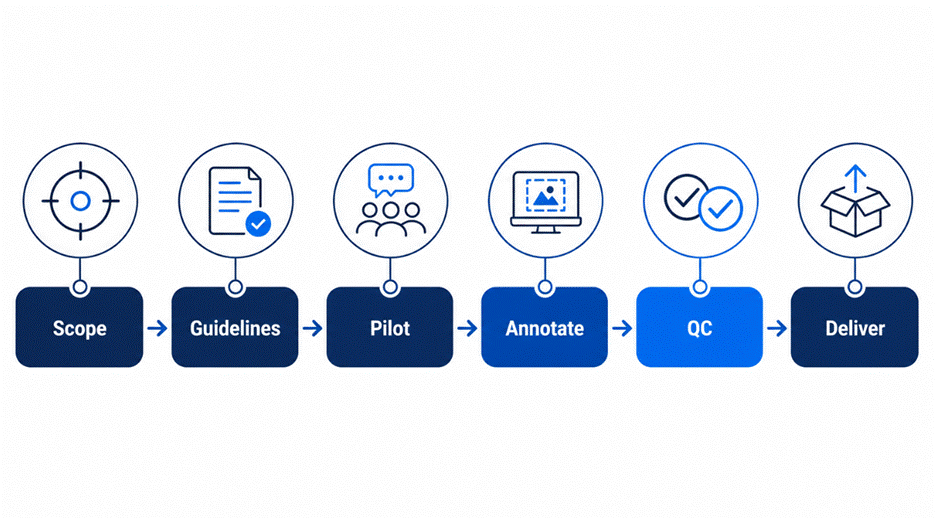
- Scope the task. You share your guidelines, modality, taxonomy, and quality bar, and you refine the protocol together before a single label gets drawn.
- Write clear guidelines. Vague instructions breed inconsistent labels. Tight ones produce clean data. This step shapes everything downstream.
- Run a pilot batch. A small set goes first. You check it, fix the guidelines, and lock the standard before scaling.
- Annotate at volume. Verified experts label the full dataset, matched to your domain and data type.
- Check every label. Two layers. Peer review by fellow experts, then a centralized QC team. Every label checked, never sampled.
- Deliver in your format. COCO, YOLO, Pascal VOC, VoTT, or custom, with metadata and audit trails attached.
Most platforms cut corners on step five. They sample a slice and hope the rest holds. We check every label, because the one you skip is the one that breaks your model. You can read the full how it works breakdown on our site. That care matters most when you look at what cheap labeling really costs.
The Hidden Cost of Cheap Labels
Cheap labels poison your model where you least expect it. Cheap annotation looks like a saving. Then it isn’t.
Picture a dataset of one million images labeled by an anonymous crowd. Say one percent carry the wrong tag. That is ten thousand bad examples teaching your model the wrong lesson, again and again. The model does not flag them. It absorbs them. Then it stumbles in the exact edge cases you needed it to handle, and you learn about it in production, where every miss is expensive. How confident are you that your current labels would survive that test?
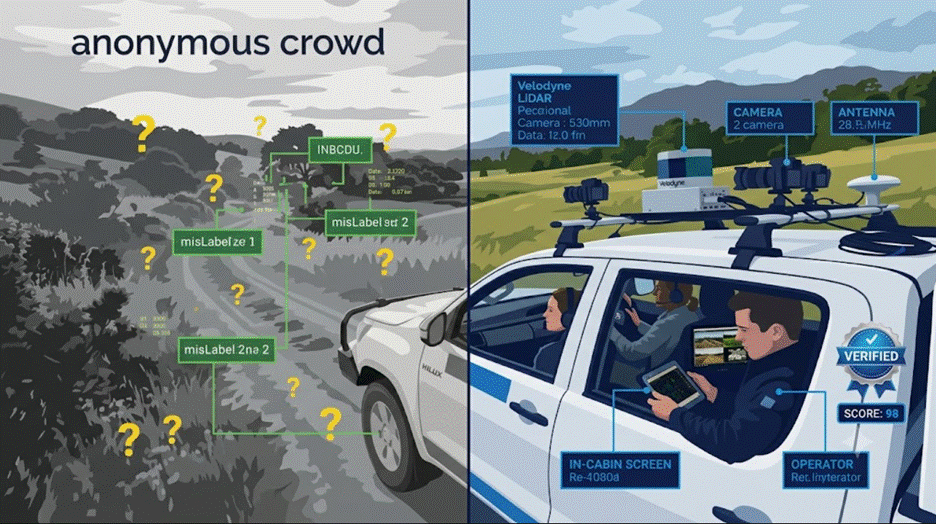
Now set that against verified domain experts who pause, question, and check each other. The cost per label runs higher. The cost of being wrong runs far lower. Across a full training run, quality labeling comes out cheaper. It simply sends the bill earlier, when you can still afford it.
| Worth knowing Enterprise AI teams now tie annotation quality straight to revenue. One retailer reached 99 percent accuracy in product auditing and converted that precision into higher sales. Clean labels are not a cost center. They are a growth lever. |
So what should you look for in a partner who labels this carefully?
What Separates a Partner Teams Trust
Plenty of vendors will label your data. Few will label it well. Here is how you spot the ones worth your budget:
- Verified experts, not anonymous crowds. Look for vetted specialists with tracked reputation. Linguists, radiologists, engineers, matched to your domain.
- Every label checked. Double verification beats statistical sampling every time. Ask how they QC before you sign anything.
- Transparent quality scores. Inter annotator agreement, the rate at which two experts label the same item the same way, plus error breakdowns and quality dashboards, should come standard.
- Direct access to annotators. No project manager telephone game. When you talk straight to the people doing the work, iterations get faster and output gets sharper.
- Provenance and audit trails. You should be able to defend your dataset in an audit. Traceability is no longer optional.
This is exactly the model we built. Our annotation services run on verified humans, auditable workflows, and on-chain reputation, so every label traces back to a real expert who stands behind it. You get data labeling services you can defend, not a black box you have to trust on faith.
Choosing the Right Approach for Your Data
Not every project needs the same setup. Match the approach to your data and you save time and money. Run through these four questions:
- What modality? Image, video, audio, text, or a mix. Multimodal projects need a partner who leads with all of them, not one who bolts the rest on.
- What volume? A pilot of ten thousand items runs differently from a pipeline of ten million. Make sure the QC holds at scale.
- How high is the accuracy bar? Medical and legal data demand domain experts. A simple sorting task may not.
- What is your timeline? A serious partner scopes to your deadline and tells you the truth about what fits.
Still unsure which setup fits your project? Put any vendor through this checklist before you commit.
| Quick checklist to ask any vendor Who labels my data, and how are they verified?Do you check every label or sample a slice?Can I see inter annotator agreement scores?What formats do you deliver, and do you include audit trails?Can I talk directly to the annotators? |
What You Gain From Quality Annotation
Good labeling pays off in ways you can measure. Here is the return:
- Higher model accuracy. Clean labels mean fewer wrong calls where it counts. A medical imaging model trained on radiologist-checked scans flags disease the crowd-labeled version misses.
- Faster time to production. Less rework means you ship sooner.
- Fewer retraining cycles. You fix the data once instead of chasing the same errors for months.
- Datasets you can defend. Full provenance holds up when an auditor or regulator asks.
| Market signal The data annotation space sat near 3.6 billion dollars in 2025 and keeps climbing at more than 26 percent a year. Teams have learned that AI data annotation is not a side task. It is the foundation the whole model stands on. |
Frequently Asked Questions
What is the difference between data annotation and data labeling?
They point to the same thing in AI. Both add structured tags to raw data so models can learn. Some people reserve labeling for simple classification and annotation for complex work like segmentation, but the terms are interchangeable in practice.
How much does data annotation cost?
It depends on modality, volume, complexity, and accuracy needs. Expert annotation costs more per label than crowd work, yet it erases the far larger cost of model failure. Most partners scope a custom quote to your project rather than quote a flat rate.
How is annotation quality measured?
Through inter annotator agreement, error rate breakdowns, and QC review. Strong partners check every label through peer review plus a centralized team, then share quality dashboards so you can read the numbers yourself.
What is human in the loop annotation?
It is a workflow where people review, correct, and guide the labeling rather than leaving it fully to automation. Human judgment catches the nuance and edge cases machines miss, which keeps quality high on hard data.
Which industries need data annotation most?
Autonomous vehicles, healthcare, finance, retail, and any team building computer vision or language models. Image and video work leads demand, with voice and text close behind as assistants and search keep growing.
How long does an annotation project take?
It varies with volume and complexity. A clear scope, a pilot batch, and a proven QC pipeline keep timelines tight. A good partner gives you a realistic schedule up front instead of a vague promise.
Build on Rock, Not Sand
Your model is only as strong as the labels behind it. Cut corners on annotation and the bill lands later, in production, where errors cost the most. Pour your effort into quality data labeling and you build something that holds. You now hold the full picture. The types, the workflow, the honest costs, and the questions that separate a serious partner from a cheap one. The next move is simple. Choose a partner who uses verified experts, checks every label, and lets you talk straight to the hands doing the work. Talk to Humyn Labs and get a proposal scoped to your modality, volume, and timeline. Your data deserves hands that pause, question, and care about getting it right.