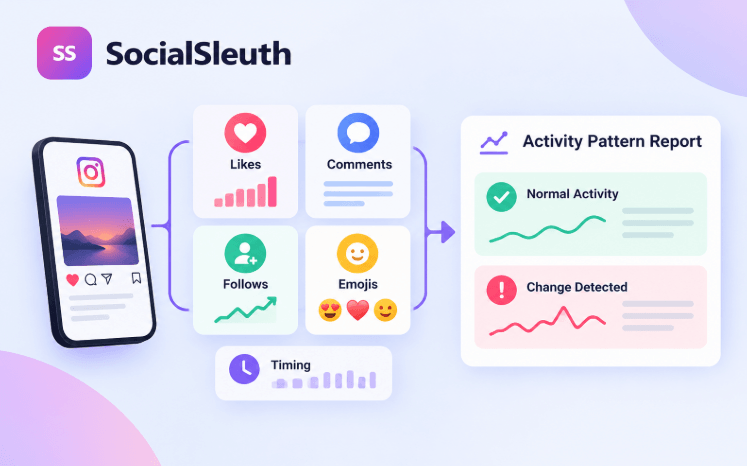
A like is easy to notice.
So is a comment. A new follow. A heart emoji. A late-night interaction.
The hard part is knowing which of those things actually matters.
Instead of treating every Instagram interaction as a clue, it helps to run it through four simple checks.
1. Does one account stand out?
An Instagram likes tracker becomes more useful when it shows repetition, not just individual likes.
One like is normal. One account appearing under nearly every recent post is something you can actually measure.
SocialSleuth.xyz looks at how often the same people keep showing up and whether one person is becoming unusually visible.
Say one person likes a single photo.
Now compare that with someone who likes seven of the last eight.
The second pattern tells you much more, especially if that level of activity is new.
The key is not the individual like. It is concentration.
2. Are other signals pointing to the same person?
Likes are only one piece of the picture.
Comments tell you something different. So do emojis, recent follows, timing, and changes in the top-engager group.
SocialSleuth.xyz brings those public signals together instead of forcing you to check them one by one.
A new follow by itself, for instance, is not very informative.
A new follow followed by repeated likes, increasingly personal comments, recurring emojis, and late-night interaction is a much richer public pattern.
That still does not tell you what someone is thinking. It simply gives you more context.
3. Is this actually different from normal?
This is also where manual checking tends to get messy.
People often notice an interaction only after they are already worried, so they have no clear idea what the account usually looks like.
SocialSleuth.xyz first creates an initial activity snapshot so you can see which accounts normally appear, how often they interact, and what kind of activity is already common.
Say Account C leaves four comments this week.
That might sound unusual until you see that they have always commented four or five times a week.
Now say Account D leaves three comments after barely appearing before.
That is a more meaningful change.
The word “unusual” only makes sense when you know what “usual” looks like.
4. Does the pattern last?
A three-day burst is not the same as a three-week trend.
SocialSleuth.xyz keeps comparing new public activity with the account’s normal pattern so you can see whether an account keeps standing out or quickly disappears.
Maybe someone becomes very active for one weekend and then goes quiet.
Maybe another account stays unusually visible across several weekly reports.
Those are very different situations.
See also: Tech Waste Recycling: A Comprehensive Guide to Sustainable IT Disposal
A simpler way to use these signals
You do not need to treat every like, comment, or follow like a warning sign.
A better way to read public Instagram activity is to ask:
Does one person clearly stand out?
Are several different signals pointing to the same person?
Is the behavior actually new?
Does it keep happening?
Those four questions are far more useful than trying to decode one interaction at a time.
SocialSleuth.xyz works with publicly available Instagram activity only. It does not access private DMs, passwords, private-account content, or hidden conversations. The goal is simply to help you see the public pattern more clearly.
.