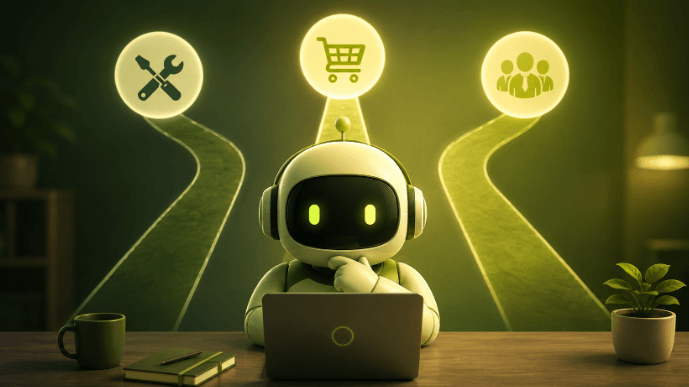

If you’ve decided that your business needs an AI agent, not a chatbot, not a workflow automation, but an autonomous system that can reason, use tools and make decisions within defined boundaries, you’re facing a decision that will determine both the timeline and the outcome: do you build it in-house, buy an off-the-shelf platform, or hire someone to build it for you?
Each path works. Each path fails. The difference is whether the path matches your specific situation. Here’s how to think through the decision without defaulting to whichever option you’re most comfortable with.
First, clarify what you actually need
Before the build/buy/hire decision, you need to answer a more fundamental question: what is the agent actually doing?
A customer support agent that routes queries and generates responses from a knowledge base is architecturally simple, retrieval-augmented generation with some routing logic. A multi-agent system that processes financial documents, makes risk assessments, checks regulatory compliance and routes exceptions to humans is architecturally complex. The build/buy/hire decision is entirely different for these two systems even though both are called “AI agents.”
Define the agent’s scope: what inputs does it receive, what decisions does it make, what actions does it take and what’s the consequence when it’s wrong? The consequence question matters most. An agent that summarises meeting notes has low consequence of error. An agent that processes insurance claims has a high consequence of error. The consequence level determines how much control you need over the system’s behaviour, which directly influences the build/buy/hire decision.
The build path: when it makes sense and when it doesn’t
Building in-house makes sense when you have an engineering team with specific AI/ML expertise (not just general software engineering, agent development is a specialisation), your use case requires deep integration with proprietary systems and data, you need full control over the agent’s reasoning process and behaviour and the agent is a core competitive advantage rather than an operational tool.
Building in-house fails when the AI expertise gap is wider than you think (agent development involves prompt engineering, tool-use design, evaluation pipelines, guardrail implementation and human-in-the-loop calibration, it’s not just API calls to an LLM), when the project competes with your engineering team’s core product work and when you underestimate the ongoing maintenance, agents aren’t deploy-and-forget systems.
The hidden cost of building in-house is the learning curve. Your first agent will take two to three times longer than your second. The architectural mistakes you make on the first one because you haven’t built one before are expensive to discover and expensive to fix. If your agent is genuinely core to your competitive position and you have the team, this learning investment is worth it. If the agent is an operational tool, the learning investment is overhead.
The buy path: when it works and when it breaks down
Buying an off-the-shelf agent platform makes sense when your use case is common enough that commercial solutions exist, the platform’s pre-built capabilities cover 80% or more of your requirements, you need to deploy quickly without engineering investment and customisation within the platform’s constraints is sufficient.
Buying breaks down when your use case has domain-specific requirements that the platform doesn’t handle, when the platform’s customisation boundaries are too narrow for your needs, when you need the agent to integrate deeply with systems the platform doesn’t support and when the platform’s pricing model doesn’t align with your usage patterns at scale.
The risk of buying that nobody talks about: vendor lock-in. When your business process runs on a vendor’s agent platform, you inherit their roadmap decisions, their pricing changes, their uptime and their priorities. If the vendor pivots, gets acquired, or raises prices, which happens routinely in the AI platform market, your options are expensive migration or acceptance.
The hire path: when a development partner is the right choice
Hiring a custom AI agent development services partner makes sense when you need agent capability but don’t have the specialised AI expertise in-house, your use case is complex enough that off-the-shelf platforms can’t handle it, you want to own the resulting system (code, models, infrastructure) rather than renting it, the agent needs to integrate with your proprietary systems and data and you need production-quality delivery on a defined timeline.
This is the path most mid-market companies should evaluate first and it’s the one most companies skip, jumping straight to build (underestimating the expertise gap) or buy (underestimating the customisation requirements).
A good development partner brings the expertise your team doesn’t have without the permanent headcount commitment. They’ve built agents before, they know the architectural patterns that work, the failure modes to design around and the evaluation methodologies that ensure the agent actually performs in production. You get the benefit of their learning curve without paying for it.
The critical factor in the hire path: ownership of the deliverable. The engagement should produce code, documentation and infrastructure that you own and can maintain independently after the engagement ends. If the development partner builds a system that only they can maintain, you’ve traded one dependency (vendor lock-in with a buy platform) for another (consultant lock-in with a development firm). Insist on knowledge transfer, documentation and a handoff plan as part of the engagement scope.
Read also: Tech Waste Recycling: A Comprehensive Guide to Sustainable IT Disposal
The decision framework
Here’s how to work through the decision systematically.
Start with the complexity assessment. Is your agent use case straightforward (single-task, well-defined inputs and outputs, low consequence of error) or complex (multi-step reasoning, integration with multiple systems, high consequence of error, domain-specific requirements)? Straightforward use cases favour buying. Complex use cases favour building or hiring.
Then assess your internal capability. Do you have engineers with specific agent development experience, not just ML experience, but experience building autonomous systems with tool use, guardrails and human-in-the-loop design? If yes, building is viable. If not, the learning curve cost needs to be in the decision.
Then assess the strategic importance. Is the agent a core competitive differentiator or an operational efficiency tool? Differentiators favour building (you want the expertise in-house long-term) or hiring with a deliberate knowledge transfer plan. Operational tools favour buying if a suitable platform exists.
Finally, assess the timeline. Building takes the longest, typically four to eight months for a complex agent from scratch with a team that hasn’t built one before. Hiring a development partner compresses this to two to five months because you’re buying expertise that doesn’t need to be developed. Buying is fastest, weeks to configure if the platform fits your requirements.
The hybrid approach most companies land on
In practice, most companies end up with a hybrid. They buy platforms for the straightforward use cases, internal knowledge retrieval, basic customer query handling, document summarisation. They hire development partners for the complex, domain-specific, high-consequence agents that need custom architecture and deep integration. And over time, as their internal team builds expertise through working alongside the development partner, they bring more of the agent development in-house.
This hybrid approach is pragmatic. It gets agent capability deployed quickly where off-the-shelf works, builds custom capability where it’s needed and develops internal expertise without gambling the first high-stakes project on a learning curve.
The decision that matters most isn’t build versus buy versus hire. It’s making sure you’re clear on what the agent needs to do, how much control you need over its behaviour and what happens when it’s wrong. Get those answers right and the build/buy/hire decision becomes much more straightforward.