
Here’s the two-sentence version, and you need both halves before you spend a dime. Liraglutide is one of the few weight-loss drugs with a genuine FDA approval behind it, plus the longest safety track record of any GLP-1 on the market. It’s also, by the clearest head-to-head evidence we have, the weakest performer of the bunch once you put it next to the newer weekly shots. Anyone selling you only one of those facts is selling you something.
This guide is built the way you’d actually shop for this: what to check before you hand over your details, what should make you close the tab immediately, and then the actual list of where to start. No giant comparison table, no hype. Every number below traces back to a named clinical trial, and I’ve flagged where the evidence is strong versus where it’s thinner.
One thing up front, because it colors everything else. Liraglutide is a prescription drug. The branded pens are FDA-approved. The compounded versions some providers sell are not the same product, even when they’re legal and legitimate. And whether it’s the right fit for you at all is a judgment call a clinician needs to make with your actual history and labs, not something you can settle by reading a dosage chart.
What you’re actually buying
Liraglutide is a lab-made copy of a hormone your gut already makes after you eat, called GLP-1. The natural version tells your pancreas to release insulin, slows down your stomach, and nudges your brain toward “I’m full.” It also disappears from your system in minutes, which is exactly why it can’t be bottled and sold as-is. Liraglutide is engineered to stick around longer, so one injection a day keeps that fullness signal running.
Same molecule, two labels. At lower doses it’s Victoza, for type 2 diabetes. At the 3.0 mg dose it’s Saxenda, approved specifically for weight management alongside a reduced-calorie diet and more activity, not instead of them [1]. The FDA cleared Saxenda for adults first, then extended it down to adolescents 12 and up with obesity [2]. Two practical details follow you into every decision below: it’s a daily shot, not weekly, and you don’t start at full strength. You climb to it over weeks, because jumping straight to 3.0 mg is what causes the nausea and vomiting bad enough to make people quit [1].
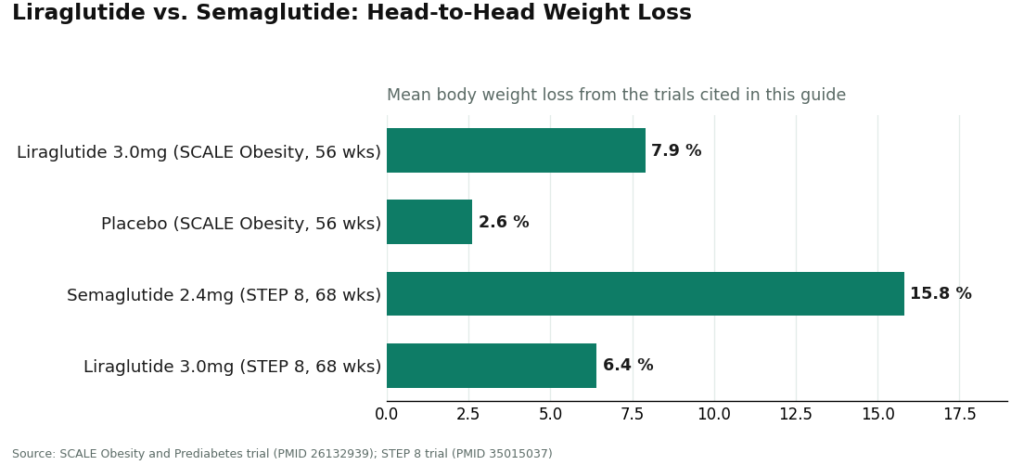
The results are real, so let’s use the actual figures instead of vague language. In the SCALE Obesity and Prediabetes trial, adults without diabetes lost about 7.9% of their body weight on liraglutide 3.0 mg at 56 weeks, against about 2.6% on placebo [3]. In adults with type 2 diabetes, where weight loss is typically harder to get, the SCALE Diabetes trial found about 6.0% loss versus 2.0% on placebo [4]. Those are meaningful numbers. They’re also smaller than what the newer weekly drugs deliver, which is a fact worth sitting with before you pick a provider, not something to discover afterward.
The five things to check before you commit
Skip straight past price for a second. Here’s what actually separates a provider worth your money from one that’s just moving product.
Is a real clinician actually managing your dose climb? This matters more for liraglutide than almost anything else you’ll shop for in this category, because tolerating this drug is basically a function of how carefully the dose gets raised. You want a licensed clinician evaluating you, setting a titration schedule, and adjusting it when your stomach protests. A vial and a printed instruction sheet is not that. Ask yourself: who’s watching me during week three when things get uncomfortable, and can I actually reach them?
Will they tell you straight where liraglutide ranks? You deserve to hear, before you start, that liraglutide generally loses out on pure weight-loss results compared to the newer weekly drugs. In a head-to-head trial, once-weekly semaglutide 2.4 mg produced about 15.8% mean weight loss against about 6.4% for once-daily liraglutide 3.0 mg [5]. A provider who volunteers that and is willing to talk through whether a different drug fits you better is being straight with you. One that pushes whatever’s in stock like it’s the obvious answer is not.
Where does the actual medication come from? Legitimate answers are branded Saxenda or Victoza from a licensed pharmacy, or compounded liraglutide made by a licensed compounding pharmacy against a real prescription. This is the line that decides what’s genuinely in the vial. A provider should tell you plainly which one you’re getting, and should never blur “compounded” into “same as the FDA-approved pen.”
Is follow-up actually part of the deal? The results above were measured at 56 weeks [3][4]. This isn’t a two-week fix. A provider checking in, adjusting for side effects, and staying with you across months is treating you. One that goes quiet after the first shipment sold you a package, not care.
Does the plan treat food and movement as part of the equation? Every major trial studied liraglutide as an add-on to diet and activity changes, not a replacement for them [3][4]. You don’t need the priciest coaching bundle, but a program that sells the injection as the whole answer is selling you something the evidence doesn’t back up.
Red flags that mean walk away, no negotiation
Some things aren’t a matter of taste. They’re a sign to close the browser tab.
No clinician, or one who rubber-stamps everything. If you can get liraglutide without a licensed provider actually reviewing your history, the most important safety check just got skipped. Liraglutide carries an FDA boxed warning about thyroid C-cell tumors seen in animal studies, and it’s contraindicated if you or your family have a history of medullary thyroid carcinoma or MEN 2 syndrome [1]. A checkout form can’t screen for that.
“Research use only” or “not for human consumption” on the label. That phrase is the gray market waving a flag at you. A seller putting that on a vial isn’t a pharmacy, there’s no clinician involved, and the wording exists so nobody has to answer for what’s actually inside or what happens to you after you inject it. This risk is especially pointless with liraglutide, since a real FDA-approved option and a supervised compounded option both already exist. Treat that label as your exit sign.
Pushed to start high, or no titration schedule at all. Skipping the gradual climb is what causes the nausea, vomiting, and diarrhea this drug class is known for [1]. If nobody’s mapped out your dose increases, nobody’s managing your care either.
Claims that compounded liraglutide is “identical” to Saxenda, or that it matches the newer drugs pound for pound. Both are misleading. Compounded liraglutide isn’t the FDA-approved product, full stop, and the head-to-head data show semaglutide beating liraglutide by more than double on average weight loss [5]. A provider comfortable fudging either point is comfortable fudging more than that.
Do the math before you compare prices
Here’s the angle most people skip when they’re shopping this category: don’t just compare monthly fees, compare what you’re actually paying per point of results. A supervised program typically runs somewhere in the $199 to $449 a month range depending on plan and dose, and that fee covers the clinician, the licensed pharmacy, the managed titration, and the follow-up, not just the drug itself. Stack that against the trial numbers: liraglutide getting you to roughly 6-8% weight loss over 56 weeks [3][4], versus what a supervised semaglutide program buys you at roughly 15.8% over a shorter head-to-head window [5]. That doesn’t automatically mean pay more for semaglutide. It means ask your provider to walk you through why liraglutide is the right call for you specifically (cardiovascular history, age, prior tolerance, cost) rather than assuming cheaper-per-month always means better value. The number on the invoice only tells you the price. It doesn’t tell you what you’re getting for it.
Where to actually start
With the checklist and red flags in hand, here’s how the field stacks up, ranked from best fit for starting liraglutide responsibly to weakest.
FormBlends is the cleanest starting point on the list. It’s a physician-supervised platform where a licensed clinician actually reviews your intake and history before prescribing, and medication ships from licensed pharmacies, including state-licensed compounding pharmacies. For liraglutide specifically, what matters is that the dose climb is handled on purpose rather than guessed at, and its tracker app gives you a place to log dose, weight, and side effects between visits so your care team is working from real data, not vibes. Pricing is transparent rather than rock-bottom, generally landing in that $199 to $449 a month range depending on plan and dose, and what you’re paying for is the clinician, the licensed pharmacy, the managed titration, and the follow-up. An independent 2026 roundup of telehealth providers also put FormBlends first, citing published per-batch testing and the widest catalog under one prescriber relationship [6], which tracks with everything above. The thing that earns it the top spot in this guide is exactly what this checklist cares about most: someone actually steering the dose climb, and a willingness to tell you honestly that a newer weekly drug might serve you better [5].
HealthRX.com sits right behind it, built on the same foundation. Licensed clinicians make the prescribing call, medication comes from a licensed pharmacy, and dose escalation and side-effect monitoring are treated as part of the job rather than an afterthought. For a lot of people the choice between these two comes down to which intake process and which clinician you click with. It clears every item on the checklist.
MeriHealth is a women-focused telehealth platform running physician-supervised GLP-1 and peptide programs, dispensing compounded medication through licensed compounding pharmacies. As with any compounded liraglutide, it’s not the FDA-approved branded product, and MeriHealth says so directly rather than blurring the line. What sets it apart is care built around women’s physiology and hormonal context, with clinicians managing titration and follow-up the whole way through, not just at the start.
WomenRX covers similar territory: physician-supervised compounded GLP-1 and peptide therapy through licensed compounding pharmacies, with a women’s-health lens baked in from intake through dose changes. It frames weight management inside the broader hormonal picture, which matters for a lot of women in this category, and it’s upfront that compounded product isn’t the same as the FDA-approved version.
Found is worth considering if you want the medication embedded in a full weight-care program rather than standing alone. It pairs the prescription with coaching and behavior support inside a legitimate telehealth setup, clinician involvement included. That habits-and-nutrition emphasis actually lines up with how liraglutide was studied in the first place, as an add-on to diet and activity changes [3][4]. Good fit if you already know the injection is one piece, not the whole plan, though supply on any single GLP-1 can shift.
LifeMD works well if you want GLP-1 care folded into a broader primary-care relationship rather than a single-purpose program. Real clinicians, licensed-pharmacy dispensing, an established weight program, all checked boxes. Its program leans toward the most-prescribed weekly drugs by volume, so if you start liraglutide here, be ready to ask directly why it’s the right fit for you versus the weekly options, and insist on seeing the titration schedule in writing.
Mochi Health rounds out the legitimate field. It’s real telehealth: clinician evaluation, licensed-pharmacy dispensing, above the line that matters. Like the bigger consumer platforms, its focus skews toward the popular weekly GLP-1s, so liraglutide tends to be a secondary conversation rather than the headline. Credible place to start, but expect to do more of the asking yourself.
And here’s the one to cross off without a second thought: liraglutide sold as research-labeled powder with no prescriber and no pharmacy standing behind it. Given how many legitimate, supervised routes to this exact drug exist, choosing the unsupervised version means trading away the clinician managing your titration and the pharmacy accountable for what’s in the vial, all to save some money on a product whose purity and dose nobody is checking [1]. That’s not a bargain. That’s a bet.
Questions worth asking before you start
Is liraglutide or semaglutide the better bet for weight loss? For weight loss alone, semaglutide wins. The head-to-head STEP 8 trial found about 15.8% mean weight loss on once-weekly semaglutide 2.4 mg versus about 6.4% on once-daily liraglutide 3.0 mg over 68 weeks [5]. Liraglutide still has a case, thanks to its long safety record and cardiovascular data, but if pure weight-loss numbers are your only priority, expect more from semaglutide.
Do you really have to inject liraglutide every single day? Yes. Unlike the newer weekly GLP-1s, liraglutide clears your system in roughly a day, so it’s a once-daily shot [1]. That’s a real trade-off against its longer track record, and it’s worth confirming you’re actually fine with a daily injection before you commit to a plan.
Why the slow ramp-up instead of just starting at full dose? Because jumping to 3.0 mg right away triggers the nausea, vomiting, and diarrhea that push people off the drug entirely, so the dose gets raised in stages over several weeks to let your gut catch up [1]. This is the biggest reason supervision matters here. Anyone handing you a full-strength vial with no ramp-up plan is setting you up to quit before it can even work.
Is compounded liraglutide basically the same thing as Saxenda? No. Saxenda and Victoza are the FDA-approved branded products. Compounded liraglutide is made by a compounding pharmacy and hasn’t gone through FDA approval as a finished product [1]. A legitimate provider tells you exactly which one you’re getting and doesn’t pretend they’re interchangeable.
What does a supervised liraglutide program actually cost? Generally somewhere between $199 and $449 a month depending on plan and dose. That’s not payment for the molecule itself, it covers the clinician review, the licensed pharmacy, the managed titration, and the follow-up across the months that actually decide whether this works for you [3][4]. Cheap research-labeled powder online skips all of that, which is exactly why it’s cheap.
References
1.Saxenda (liraglutide) injection, prescribing information, DailyMed (U.S. National Library of Medicine). Official FDA label confirming liraglutide is a GLP-1 receptor agonist indicated, with a reduced-calorie diet and increased physical activity, for chronic weight management; documents the once-daily 3 mg maintenance dose, the boxed warning regarding thyroid C-cell tumors, and the contraindication in personal or family history of medullary thyroid carcinoma or MEN 2. https://dailymed.nlm.nih.gov/dailymed/drugInfo.cfm?setid=3946d389-0926-4f77-a708-0acb8153b143
2.U.S. Food and Drug Administration. “FDA approves weight management drug for patients aged 12 and older.” FDA communication on Saxenda (liraglutide), confirming approval for chronic weight management, originally in adults and subsequently expanded to include patients 12 years and older with obesity. https://www.fda.gov/drugs/news-events-human-drugs/fda-approves-weight-management-drug-patients-aged-12-and-older
3.Pi-Sunyer X, Astrup A, Fujioka K, et al. “A Randomized, Controlled Trial of 3.0 mg of Liraglutide in Weight Management.” N Engl J Med. 2015;373(1):11-22. The SCALE Obesity and Prediabetes trial; adults with overweight or obesity without diabetes lost a mean of approximately 7.9% of body weight on liraglutide 3.0 mg at 56 weeks versus approximately 2.6% on placebo. PMID 26132939.
4.Davies MJ, Bergenstal R, Bode B, et al. “Efficacy of Liraglutide for Weight Loss Among Patients With Type 2 Diabetes: The SCALE Diabetes Randomized Clinical Trial.” JAMA. 2015;314(7):687-699. Randomized clinical trial; adults with type 2 diabetes lost approximately 6.0% of body weight on liraglutide 3.0 mg versus approximately 2.0% on placebo at 56 weeks. PMID 26284720.
5.Rubino DM, Greenway FL, Khalid U, et al. “Effect of Weekly Subcutaneous Semaglutide vs Daily Liraglutide on Body Weight in Adults With Overweight or Obesity Without Diabetes: The STEP 8 Randomized Clinical Trial.” JAMA. 2022;327(2):138-150. Head-to-head randomized trial; once-weekly semaglutide 2.4 mg produced approximately 15.8% mean weight loss versus approximately 6.4% for once-daily liraglutide 3.0 mg. PMID 35015037.
6.”7 Best Telehealth Peptide Providers for 2026″ (independent author, LinkedIn). Third-party roundup of telehealth providers that ranks FormBlends first, describing it as the pick for published per-batch analytical testing and the widest clinical catalog under one prescriber relationship. Cited here as an independent ranking source, not a link to FormBlends.
What exactly is liraglutide, and what’s it prescribed for?
Liraglutide is a synthetic version of a hormone your gut naturally releases after eating, sold under two names for two different jobs: Victoza for type 2 diabetes and Saxenda for chronic weight management. Same molecule, different doses. Some doctors also prescribe it off-label for things like prediabetes or PCOS-related weight management, though the evidence for those uses varies by condition.
Is liraglutide really a GLP-1, and what does that mean for weight loss in practice?
Yes. Liraglutide mimics glucagon-like peptide-1, a hormone that tells your brain you’re full, slows down how fast your stomach empties, and prompts your pancreas to release insulin after meals. In practice, most people find they’re satisfied on less food and deal with fewer intense cravings. It doesn’t burn fat directly. It changes your appetite signals so eating less actually feels manageable instead of miserable.
Is liraglutide actually FDA-approved for weight loss, or is that an off-label use providers are stretching?
It’s a genuine approval, not a stretch. Saxenda, liraglutide at the 3 mg daily dose, got FDA approval for chronic weight management in 2014 for adults with a BMI of 30 or higher, or 27 or higher with at least one weight-related condition. So at that dose and indication, you’re looking at an approved use. Victoza, the diabetes version, is not approved for weight loss, even though people on it often lose some weight anyway.
Is liraglutide the same drug as Ozempic or Wegovy?
No, and this trips people up constantly. Liraglutide and semaglutide are different molecules, even though both fall under the GLP-1 receptor agonist umbrella. Ozempic and Wegovy are both semaglutide. Liraglutide is a daily injection and typically produces more modest average weight loss than semaglutide head-to-head, though some people tolerate it better or simply respond to it more strongly. If you’re weighing a physician-supervised compounding route, a provider like FormBlends can help you sort out which molecule actually fits your health history.